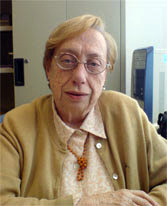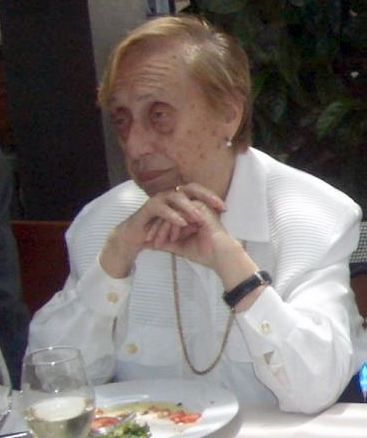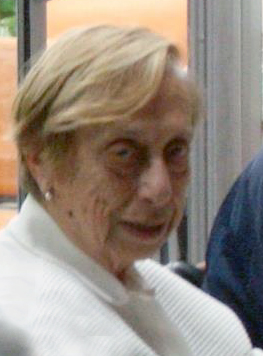
Maria de Bolòs i Capdevila, Daughter of a Lineage of Naturalists
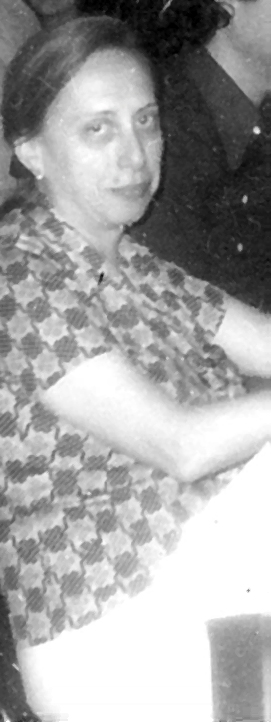
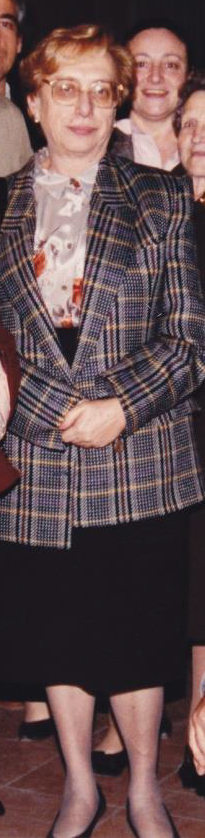
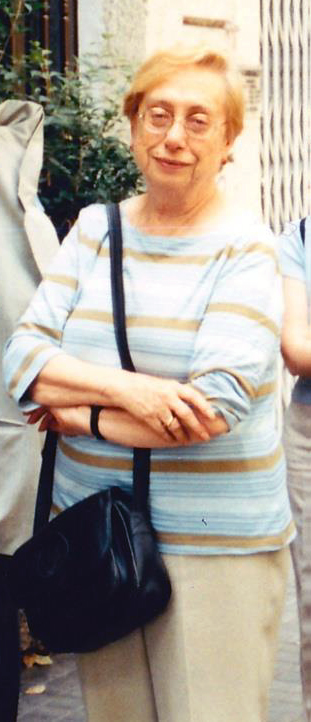
Maria de Bolòs i Capdevila (Olot, 1926 – Barcelona, 2024) came from a family of artisan pharmacists with a strong interest in the natural sciences. She was descended from Joan Minuart Parets (1693–1768), a distinguished botanist and one of the most notable members of the new Jardín Botánico [Botanical Garden] in Madrid. One of his daughters, Teresa Minuart, married Antoni Bolòs i Ferrusola, a prominent pharmacist and scholar of plants who carried out various botanical studies.
The family tradition of pharmacy was continued by Miquel Bolòs i Minuart and later by his son Francesc Xavier Bolòs i Germà, the best-known member of the family for his scientific work in botany, geology and meteorology. A great-grandson of Joan Minuart, he acquired extensive botanical knowledge, became a correspondent of the Jardín Botánico in Madrid, and wrote a catalogue of the plants of Olot. He was also the first to produce a monograph on the volcanic activity of Olot.
The dedication to pharmacy was carried on by his son Josep Oriol Bolòs i Santaló and by the latter’s son, Ramon de Bolòs i Saderra, Maria de Bolòs i Capdevila’s grandfather. Ramon de Bolòs married Assumpció Vayreda i Vila, sister of the botanist Estanislau Vayreda, the painter Joaquim Vayreda and the writer Marià Vayreda. Once again, the Bolòs family line became linked to one of the most prominent families not only in the intellectual life of Olot, but also in the cultural and political Renaixença [Catalan Renaissance] of Catalonia during the final quarter of the nineteenth century.
Ramon de Bolòs i Saderra also took an interest in botany and carried out several collections of plants and mosses. His son, Antoni de Bolòs i Vayreda, also studied pharmacy and married Maria Capdevila, daughter of the notary of Olot. However, after being imprisoned twice in Olot for his Catalanist views during the dictatorship of General Primo de Rivera, he decided to leave his native town. He sold the family pharmacy in Olot and bought another in the Eixample district of Barcelona, where the whole family moved in 1927. Maria de Bolòs i Capdevila, born in 1926, was then just over one year old.
As a daughter of Olot, her given name was Maria del Tura, in honour of the city’s patron saint, venerated at the Sanctuary or Church of Santa Maria del Tura, also known as Mare de Déu del Tura [Church of Our Lady of Tura]. Nevertheless, she signed her works as Maria de Bolòs, and this is how she was known and addressed within academic circles.
The Path Towards Geography
Her family’s naturalist heritage is essential to understanding the foundations of her knowledge. Pharmacy, with everything it entailed at that time, family conversations, the books she saw on the shelves at home and curiously leafed through — and occasionally read — as well as the herbarium sheets and field notes of her father and brother, all offered her a distinctive view of the world that she would later channel into geography. She began studying Philosophy and Arts at the University of Barcelona in 1948, although in an environment very different from that of her home, both in subject matter and perspective. She graduated in 1953.
However, she gravitated towards highly respected teachers and colleagues whose lectures she attended, whom she questioned during meetings and seminars, and with whom she shared discoveries on field trips. Among these figures were Pierre Deffontaines, Josep M. Fontboté, Josep Iglésies, Salvador Llobet, Oriol Riba, Lluís Solé, Sabarís, Joan Vilà i Valentí and Carmina Virgili, among others. From 1953 onwards, she frequently attended the Institut Elcano of the C.S.I.C. [Spanish National Research Council] and the University’s Geology Laboratory, where she worked alongside Salvador Llobet and Lluís Solé Sabarís respectively.
Maria de Bolòs became a geographer in her own way. Initially from a broad perspective, and later through a regional approach following the French school, she completed her doctoral thesis on the Garrotxa region (1966), later published in full by Edicions de la Universitat de Barcelona [University of Barcelona Press] in 1977. This work formed the basis for the chapter on Garrotxa in the Geografia de Catalunya [Geography of Catalonia], directed by Solé Sabarís and published by Aedos. Maria de Bolòs herself also wrote the chapters on the regions of Gironès and La Selva.
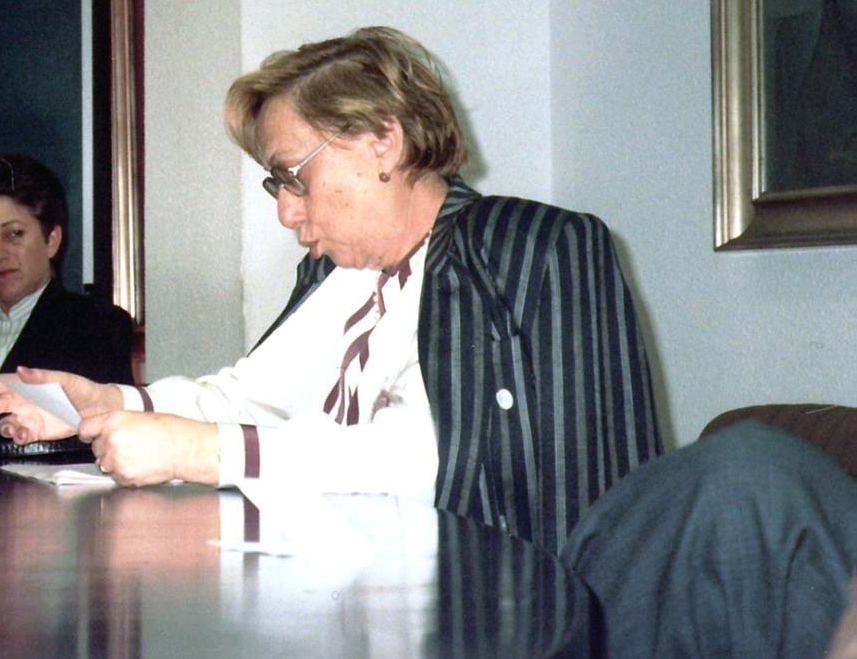
As was common in her time, gaining a professional foothold at university was far from easy, and she had to undertake a wide variety of jobs in order to make a living until she was finally able to establish herself, eventually becoming Professor of Physical Geography. Among other activities, she worked in publishing, editing and proofreading, which gave her a broad understanding of historical and cultural realities that later proved highly valuable in her landscape research. In 1964 she began teaching at the University of Barcelona, initially combining this work with editorial tasks. In 1981 she obtained the post of Professor of Physical Geography, becoming the first Spanish woman to achieve this distinction. She retired in 1991.
At first she taught general geography courses, but she later devoted herself to the two subjects she most enjoyed and in which she specialised and conducted research: biogeography and landscape studies.
The Science of Landscape
Initially, Maria de Bolòs focused on regional geography and biogeography, but her greatest contribution was in the field of landscape science. Her most important work in regional geography was the systematic study of the Garrotxa region, which she presented as her doctoral thesis. However, at the end of the 1960s, the Maluquer Plan established the Department of Geography and the Geography degree programme. At that point, three main lines of research in Physical Geography became consolidated: geomorphology, climatology and biogeography. Maria de Bolòs was entrusted with teaching and organising biogeography, which until then had been included within the broader subject of Physical Geography. This represented a challenge for her, despite her considerable grounding in the biological sciences, especially botany. Yet biogeography as taught from a geographical perspective encompassed contents and approaches that had not previously been considered. Gradually, she consolidated the subject through new approaches.
In seeking to define the place of biogeography, she encountered broader conceptions of the environment that extended beyond biological, geomorphological, climatic, hydrological and soil realities, while also encompassing the human dimension. The turning point came with the visit to Barcelona of Professor George Bertrand from the University of Toulouse-Le Mirail, who had recently published several works on the role of Physical Geography and proposed Landscape Science as a “diagonal science” (1972).
From that moment onwards, Maria de Bolòs prioritised her teaching and research activities towards the study of landscape, which she regarded as one of the principal objects of geographical studies. She created working groups and organised seminars, colloquia and conferences on landscape. She directed research projects and coordinated applied studies in landscape analysis. The culmination of Maria de Bolòs’s contribution to landscape studies was the publication of a handbook on the theory, methods and application of Landscape Science (1992).
Selected Publications
- Bolòs, M. (1959). La inmigración en Barcelona en los últimos decenios. Estudios geográficos, Vol. 20, pp. 209–249.
- Bolòs, M. (1964). El Gironès. In Solé Sabarís, Geografia de Catalunya, Editorial Aedos, pp. 409–436.
- Bolòs, M. (1964). La Garrotxa. In Solé Sabarís, Geografia de Catalunya, Editorial Aedos, pp. 385–408.
- Bolòs, M. (1964). La Selva. In Solé Sabarís, Geografia de Catalunya, Editorial Aedos, pp. 437–460.
- Bolòs, M. (1975). Paisaje y ciencia geográfica. Estudios Geográficos, Vols. 138-139, pp. 93–105.
- Bolòs, M. (1977). Aproximación al estudio del hombre como elemento y factor del paisaje. In Actas del V Coloquio de Geografía, 161–168. AGE.
- Bolòs, M. (1977). La comarca de Olot. Estudio de Geografia Regional. Barcelona, Edicions de la Universitat de Barcelona.
- Bolòs, M. (1979). El paisaje vegetal y su estudio geográfico. Actas del VI Coloquio de Geografía, pp. 153–156.
- Bolòs, M. (1981). Problemática actual de los estudios de paisaje integrado. Revista de Geografía, Vol. 15, pp. 45–68.
- Bolòs, M. (dir.) (1983). L’eix del Llobregat i el Túnel del Cadi. Túnel del Cadi, S.A. i Servei de Gestió del Paisatge. Barcelona: Publicacions i Edicions de la Universitat de Barcelona, 396 pp.
- Bolòs, M. (1983). Las tendencias del paisaje integrado en España. Primer encuentro de geógrafos vascos y catalanes, Sociedad de Estudios Vascos, Vol. 1, pp. 77–91.
- Bolòs, M. (1987). Nuevos conceptos en estudios aplicados de paisaje integrado. Anales de Geografía de la Universidad Complutense, Vol. 7, pp. 15–19.
- Bolòs, M. (dir.) (1992). Manual de Ciencia del Paisaje. Teoría, métodos y aplicación. Barcelona, Masson, 273 pp.
- Bolòs, M. (1992). Los estudios de paisaje en España. In La Geografía en España (1970-1990). Aportación Española al XXVIl Congreso de la Unión Geográfica Internacional. Washington, 1992. Fundación BBV, Madrid, pp. 321–324.
- Bolòs, M. (1996). La vegetació d’Andorra. Ministeri d’Educació. Govern d’Andorra. Andorra la Vella.
- Bolòs, M.; Herail, G. (dirs.)(1975). La acción humana en el paisaje. El caso de la Conreria (Cordillera Litoral Catalana). Revista de Geografía, Vol. 9, 5–34.
Written by
This text was written by Josep Maria Panareda Clopés, who holds a degree in Geography and History from the University of Barcelona (1973), a diploma in Advanced Studies in Ecology and Physical Geography from the University of Toulouse-le-Mirail (1974), and a doctorate in Geography from the University of Barcelona (1978) with a thesis on the dynamics and evolution of the Montseny landscape. Until 2012, he was a professor in the Department of Physical Geography at the University of Barcelona, where he taught courses in cartography, physical geography, biogeography, and landscape.
Image gallery